Tuesday, July 20, 2010
Nuclear waste wines...
Mobile devices.....
So what have mobile devices got to do with home brewing?
Well, you may or may not be aware that we all have different access to different kit, or levels of service, etc etc.
So I'm trying to set this blog up so that Keith can actually post to it. Being in rural Oklahoma, he is limited by bandwidth and has had to opt for using a PDA/smartphone for his phone and net access. It's proving a complete PITA as I'd like his input as he knows shitloads about home brewing of wines and meads.....
I just, apparently, managed to "register" this device, sent a message, but as yet, absolutely sod all has appeared.....
So here goes for a second time......
Sunday, July 04, 2010
More "treasure".......
What is it? It's 14 kilo's of finest Polish buckwheat honey.
It's been a long time coming.
One of the chaps over at Gotmead was kind enough to offer to get some for me as it's proving damn near impossible to obtain any in the UK for anything that might resemble a reasonable price. Marek sorted the order for me and then I had to arrange with Sebastian, a former work colleague, so that Marek could get it sent to Sebastians home in Poland, who in turn would then bring it back with him on return from one of his regular visits to his family. I can't put into words how grateful I am to both of them for their assistance in getting this to me.
I'm still of 2 minds as to what I'll actually turn it into. Though I'm thinking along the lines of a gallon batch of a straight traditional mead, plus a batch of one of the "easier" Polish style meads.
Called "Czwórniak", it's basically 1 part honey to 3 parts water. With that ratio or honey/water, I'd guess that it would still work out as quite a high gravity, so I'll have to measure it out and then see how it's likely to measure up. There'd be no point in mixing it up and then hoping that it will work out Ok. It could easily end up killing the yeast if it's too high a gravity.
At this point, I'm not even sure how it'll work out. I've had a read around about meads like this and there's both EU and Polish Government regulations on how it should be made, so I'd like to stick to the rules if possible, but I might have to divert some to get it to work - I'll see and post back on the subject........
Sunday, June 27, 2010
A nice comment........
If you want to check it out, you'll see that Keith has left a nice comment at the last post where I announced him as an author.
His post is correct. It's really all about improving the quality of the brews we make.
Sure, it's entirely feasible that we might get to a point where any further improvement isn't possible without adopting commercial techniques, but it sure as hell shouldn't stop us looking should it.........
Oh and I'm sending this via email to prove that it's still working Ok and I only couldn't send the message from the normal account as it's getting messed about by the provider, though it seems to be to do with it having the address harvested/spoofed........ so watch this space.......
Thursday, June 10, 2010
A new author.........
I started this blog as a record of my home brewing efforts.
It happens, that through my mead making efforts, I've got to know Keith Hardesty. Initially I met up with Keith through a wine making forum.
Since then, it's been a case of a weekly conference call/video conference. It depends on what's available as I'm on the south coast (UK) and Keith is in very rural Oklahoma.
He's a good bloke and he has some brilliant ideas of ways to make meads of various types, so after we chatted about "spreading the message" we decided that as a convenient outlet, he should also post here and make it a bit more international and open.
I'll be more than pleased if he posts some of his methods, techniques and enthusiasm here as it'd save me trying to post them ;-)
Others in the mead world may have already heard of Keith as it seems that he's been around the online meadmaking world for some time.....
Brilliant! Go on Keith, get "scribbling".......
Sunday, June 06, 2010
A little bit critical ???
Been trying to get my head round the linked thread above for a couple of days.
Now for reasons I don't quite get, I'm failing dismally, in managing to get any entusiasm (or full understanding) for this. After all, it's a commercial technique, and commercial techniques are pretty much, about maximising the £$€£$€£$€!
{edit}I've decided to delete the rest of this entry, as it'd be rather dis-ingenuous of me to post it here.
After all, I couldn't tell the difference between Malolactic fermentation and a bubbly fart!{/edit}
Hey ho!
Sunday, May 09, 2010
update 9/5/10
Anyway, I got an extra couple of jars of Mexican Clear and had to get a 3lb pot of Italian Chestnut as the chap said it was the last of it, something about poor harvest and the lousy summer last year. Shame as it's very nutty/malty and not as "sweet" as a lot of their honey, quite dark in colour. I also had to go to the local Lidl to get another bottle of the Marlene Summer Blossom blended stuff.
The plan was to add an extra measure of honey to the 3 batches from last week. I did screw up a little, as I managed to put the Mexican in the Marlene and vice versa. Perhaps I should have turned the light on and double checked the labels on the DJ's! Anyway, it should still come out ok, as they'll be finished off with the correct honeys when back sweetening.
All I've done is to add the honey, but also a 1/4 teaspoon of FermaidK and 1/4 teaspoon of DAP (Di-Ammonium Phosphate). Which has been added to some must taken out to check the gravities and stirred in with the milk aerator, poured back into the respective DJ, which is then topped up with water (gently as there was still a little foaming, just nowhere near as much as last week).
The changes in gravity were approximately 40 points i.e. one measured about 1080 and the lowest was about 1060 so all on target. Apart from aerating yesterday, I'm not intending any further aeration hence them being topped up with water to the neck of the DJ and being airlocked for the duration.
Monday, May 03, 2010
Mead update 3/5/10
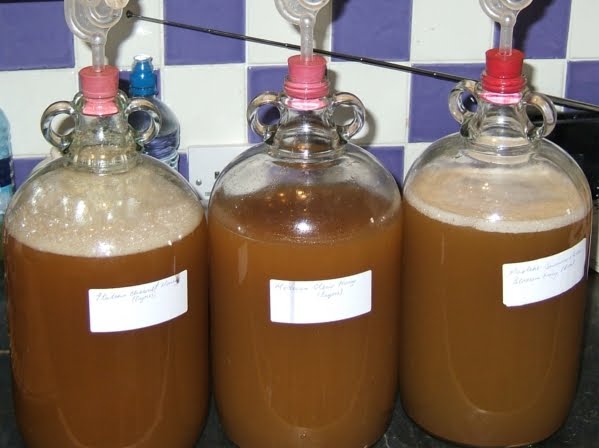
I'd already pitched the yeasts if you recall, the Italian Chestnut Honey and Mexican Clear Honey batches with D21 and the Marlene Summer Blossom honey with K1V-1116.
The batch on the right is the Marlene Summer Blossom honey. Now you might be wondering what it is that I've done, and equally, why 2 different batches/yeasts etc are showing foam on the top and one not.
Well, to start with, I've taken a pint glass, a meat baster, measuring spoons and a milk aerator (for making the milk frothy before pouring it on the coffee), sanitised them. Then one batch at a time, I've withdrawn about half a pint of the must, put it in the pint glass, then added 1/2 a teaspoon of FermaidK yeast nutrient and with the milk aerator, it's been agitated. This is for 3 reasons, firstly it will remove any extra CO2 that is starting to build up, second, it will aerate the must with some additional oxygen from the air and thirdly it will also dissolve the yeast nutrient, which is just as important because when the must is gently poured back into the rest, you don't want to disturb it so much that it causes the must to foam out over the top of the fermenter.
That has been done for all 3 batches. The middle one shows that some batches of must won't always foam like hell, whereas you can probably make out the difference in the amounts of foam that have been produced by the other two, the Italian Chestnut batch having foamed the most.
It's for reasons like that, that some makers will initially make a batch in a bucket that is larger than the actual batch. Because when you're adding adjuncts like nutrient, or acid, or whatever, once a ferment has started it will foam like hell when the additions are put in or sometimes if you are aerating it in the early stages of fermentation.
You don't want to lose any of the mead do you! That was why I mixed the nutrient in with the frother, it enabled me to pour it back into the batches without agitating it too much. None of them foamed out over the top.
Now they'll probably get aerated gently once a day, until the gravity drops to about 1020 or so. One thing I haven't mentioned is that I might add a small amount more nutrient, at the 1/2 sugar break i.e. when the gravity has dropped to about 1055 or there abouts, I'll add something like 1/8th teaspoon of FermaidK and 1/8th teaspoon of DAP (Di-Ammonium Phosphate). Then at 1020 I'll top them up and then leave them to ferment dry, and too start clearing/dropping sediment naturally.
That might seem like a lot of faffing about, but it's about how you're caring for the yeast. If it's well nutured, then it's less likely to cause "off flavours" in the mead, at the same time it should normally allow the ferment to finish reasonably quickly. After all, if you're putting in the effort to try and produce a quality tasting mead you don't want to do anything that might damage or otherwise mess up the taste.
Well that's the idea behind it anyway.........
Oh, and before I forget, the reason that I've added the yeast nutrient now, rather than before pitching the yeast, is that it's the Lallemand/Lalvin recommendation that you use GoFerm when rehydrating the yeast as it contains all the goodies that the yeast needs when it's being woken up from the dried state, whereas the yeast nutrient contains different levels of different stuff, that the yeast needs when it's actually fermenting. I don't know the exact differences - there's probably more info about it if you search the web.
Sunday, May 02, 2010
update 2/5/10
I've just checked the starting gravities and all 3 are showing about the 1.100 mark i.e. the Marlene Summer Blossom being the same as the Italian Chestnut and the Mexican Clear, which suggests that it's got a higher percentage water than the other two - whether thats extra water added during blending or not, I can't say.
I'm currently in the middle of rehydrating the yeasts. That's with about 100mls of water, 1 teaspoon of GoFerm and the yeast. The pack of the K1V says (as usual) that it's supposed to be 50mls of water at 40 to 43 degrees C. I've made it a bit cooler, about 35 degree's C before mixing in the GoFerm, then adding the yeasts to the glasses. It's also supposed to be like that for no longer than 15 minutes but I'm not so fussed about that. It's always worked Ok for me in the past if I've left it for longer, especially when rehydrating with GoFerm as well as just water.
Hell, I could have made yeast starters, but I haven't found that necessary.
Saturday, May 01, 2010
Update #2 1/5/10
This is the "Mexican Clear" honey.
This is the "Italian Chestnut" honey.
This is the "Marlene Summer Blossom with Wild Blossom" honey (from Lidl's).
The idea of standing the DJ's on the torch isn't so that you can see 3 badly taken pictures but as they've been mixed up identically, you can see by the different amounts of light that's getting through the batches and the different colouration of the honeys.
This is the"Marlene Summer Blossom with Wild Blossom" honey taken with the camera flash switched on.
This is the "Italian Chestnut" honey - camera flash on.
Finally, this is the "Mexican Clear" honey as above.
Now, I hope that you can see that they are all quite dark, but still different shades of colour. Their aroma was very different as well. The strongest smelling was the Italian Chestnut, the lightest smelling was the "Marlene".
The intention is to use Lalvin D21 yeast in the Chestnut and the Mexican - and because I've now run out of D21, the Marlene honey will have to have K1V-1116 yeast.
Oh and before I forget, the "Mead Acid" I mentioned before, well that's from Ashton and Duncans book "Making Mead". It's nothing special really, just a mix of 2 parts Malic acid to 1 part Tartaric acid. I know I should have measured the pH before starting but I can't be arsed.......
So apart from the different yeasts, the only other difference will be that once they've cooled down so I can measure the starting gravity, I expect the Marlene honey batch to be higher than the other two, because they came in 1.36kg buckets while the Marlene honey came in 3 x .5kg retail packs (it seems that while most UK "brands" of honey will supply in either 1lb/454gm or 12oz/340gm packs, all the ones from Lidl's that I've tried have come in 500gm retail packs - hence the expected higher gravity - I'll know once the measurements have been taken).
I'll also be hydrating the yeasts with Go-Ferm yeast hydration nutrient, not because it's necessary, but I've got some so I'll use it. This just means that I won't be putting any yeast nutrient in too start with, because the recommendations for Lalvin FermaidK yeast nutrient are too add it when the "lag phase" of the yeast has finished i.e. when there's visible signs of the fermentation having started. It's also why I haven't topped them all the way up yet - there's room for some foaming, which I suspect will occur when I add the FermaidK though I'll remove a little of the must and mix it with water and mix the nutrient into that so that it can be added carefully but slowly - I hope that will negate any excess foaming of the batch and then they can be topped up with water later on.
I'm not worried about oxidisation, because while there's a small(ish) air space in the DJ's at the moment, it will have expelled just about all the oxygen in the air with the CO2 that will be coming off it once the ferment has kicked off.
I'm posting the progression like this, so any reader will hopefully, be able to follow the progress of these 3 batches and not just try to understand how I'm doing this from text alone - pictures make it easier to follow (well I think so anyway).
TTFN!

