So, ok, I've been putting more thought into what it is that I want, or are at least aiming for....
What is it then ? Well, I "think" I'm aiming for a strong(ish) mead, that has good aroma, but also a distinct honey taste. Sweet, well sweetish, though not as cloyingly/sickly sweet as the commercial meads I tasted the other year. So I'd guess something that has a final gravity of around 1.010 to 1.020 and not the 1.040 mark of the commercial ones mentioned before, they were just like drinking watered down honey.
The actual honey type may, or may not be an issue, as might the yeast(s) used. I sort of like the idea of using D21, which according to the writings of the late Brother Adam (of Buckfast Abbey, bee breeding/mead making fame) alluded to as being a good yeast for meads. But, when I dig around, there's a lot of other yeasts used, especially by the members over at Gotmead. The problem is, that apart from the "usual suspects" by Lalvin/Lallemand i.e. EC-1118, K1V-1116, D47, 71B, RC-212, they (Lalvin/Lallemand that is) do a hell of a lot of different yeasts. So which one is likely to be the best for meads like that ?
There's also the issue, of whether they're available in "home brew sized packs". A lot of them aren't, but if I could only work out the best choice, even if it's not available in home brew packs ("morewine" seem to repackage some that are normally only available in commercial size packs/quantity).
I've seen mention of DV10, ICV-D80, ICV-D254 and R2 also used successfuly in mead making (remember, that some, like RC-212 and R2 are mainly for "reds") so whether I'd need to check those out as well.
As for the honey ? Well, yes, it's possible to get honey from lots of places, plus from a lot of the reading that I've done, it suggests that the strongest tasting, darkest coloured honeys are the best for mead making. Though higher levels of alcohol and sweeter tastes suggest making meads more of a port/sherry type (not using the same techniques, just sweeter and darker etc). For anyone who reads this blog, you'll know that with the kind help of one of the members at Gotmead and a work colleague, I managed to get hold of a 14kg bucket of Buckwheat honey from Poland. Now this isn't quite like the Buckwheat I've read about in many places, it's not as dark as I'd expected, though it is darkish. Plus it's different tasting, but doesn't seem to have the "farmyard" type character I'd read about, but it is quite "malty" tasting and less of the strong honey taste you get from a lot of the blended honeys (blended for eating/cooking I'd guess).
Realistically speaking, I have to rely on what is available from Paynes, my local honey wholesaler. Who have some nice honeys, but not a huge range and nothing like the wonderfully exotic sounding honeys available from places like the Bee Folks and other wholesalers in the US.
Of course, not all of the ones available from the Bee Folks (and similar wholesalers) would lend themselves to mead making, but there's also the problem of shipping. For example, having worked my way through their website, it seems that the cheapest method of shipping would be the USPS (the United States Postal Service). So to make it anywhere near cost effective, (I've used a 5 gallon/60lb bucket of "Killer Bee" honey in my example - which would cost £153.98 at the moment) the cheapest method of shipping is "USPS Priority Mail International" and that's gonna cost £143.21 so only about £10 less than the honey (I don't mind that it might take a while to get here). So the cost of the honey would be £297.19 which equates to £4.95 per lb of honey. That's the kind of price I'd expect to pay for a "very premium" type honey, like Scottish Heather honey. But it's the cheapest way to get it from the US.
So, as you can see, all the "what's best" kind of thing is a bit of a PITA.....
Ah well, I guess I'll just plough on and try to make meads that have come out better than most of my attempts have thus far........
Sunday, November 07, 2010

Saturday, November 06, 2010
Disheartening Results..........
Been a "busy bee" today, as there was about 10 or 11 gallons of various brews that needed racking etc....
So why the strange thread title ?
Well, it's one of those days where I've got the "WTF" thoughts going through my head.
Why ? Well as I was racking various brews, not many of them taste like I think they should. And I don't really know why that is.
For instance, a good few years ago, a reasonably local brewery, not only made some excellent beers (real ale type), but they also made a range of country wines. I'd tasted about 5 or 6 of these and the only way I can describe my memory of them is as "alcoholic fruit cordials".
Now a lot of my knowledge and understanding of how wines "should" be made comes from the great and good at places like Wines at Home and Gotmead etc etc.
So, what if the "wine making" methods that are taught, explained and encouraged at these excellent places, are wrong. That's not to be critical of what they're about, but the fruits and flavours used in "Country" wines aren't grapes, so why does it seem that my country wines just taste like mediocre or badly made grape wine ? Or why is it that my meads mostly have a reasonably "honey like" aroma but don't seem to reflect that in the taste ?
Of the multitude of gallon batches I've just been working with, 1 of the meads and one of the fruit wines (actually, it was mixed fruit melomel), nearly tasted like I thought they should.
Unfortunately for me, the mead was one that I'd forgotten to label, and hadn't checked properly when it was fermenting as I measured the gravity and it was sitting at 1.020 so not as sweet as a dessert mead, but certainly nowhere near dry (and probably not finished it's fermenting - which is too late now as it's been racked, sulphited, sorbated and then topped up with an unimpressive chenin blanc that I made by accident....). The mixed fruit melomel has a light almost rose colour, a good level of fruitiness to the taste, but not a lot of body. Still the taste, apart from the lack of body, was good, so it's also been racked and then I've topped it up with sour mash whisky.
Perhaps it's that I'm not as conscientious in my efforts, maybe I should make more effort to record what I do so I can repeat the recipes, maybe I should just make high alcohol meads that are then topped up with honey syrup and then left to age in bulk. Damn I just don't know.....
There was 4 other "reds" amongst the many brews, 2 of them showed a little promise, inasfaras, they actually had some taste of what they were intended to be, I could taste the black currants in the black currant melomel and the raspberry in the apple and raspberry melomel. So I've just racked them out of their respective 1 gallon jars into a 5 gallon jar, topped it up with some of the mediocre chenin blanc wine, added about a half pound of frozen black currants that I had, so I'll leave it to steep on the small amount of fruit and then I think I'll add some honey syrup at a later stage to sweeten it up and then put it away to age (after I've removed the fruit). I might even add some whisky or brandy just to up the alcohol content as well.
Last time I "went through my brews" that needed something doing to them, I just took all the ones I didn't like or weren't looking like they showed any promise and took them to a friend who has a still and chucked the lot through that, to recover the alcohol so I could fortify some other brews.... And got a telling off from Keith for being to impatient.
I suppose half the problem is that I don't know any other home brewers/home wine makers around here to compare brews. I don't even know if I'd want to compare brews, especially if it turned out that mine were a load of shit......
I'll just have to think about how (or if) I want to continue.........
Sunday, October 24, 2010
First Sloes.....
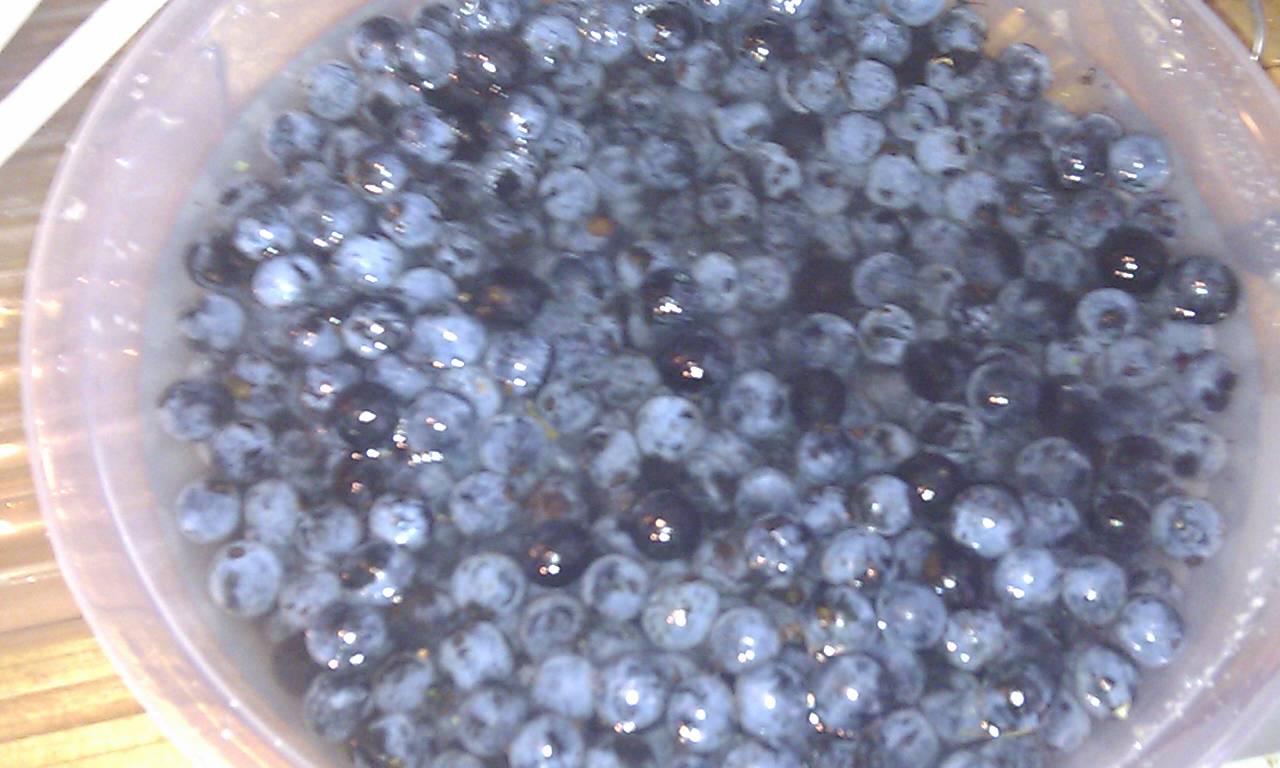
Once defrosted, mix the gin and sugar together. It'll need a quick shake daily until the sugar has dissolved (and you'll be surprised how long that can take).
Once you've got enough for a 1 gallon demi-john (about 4lb of sloes, 4 pints gin and 1lb sugar) you can add a little spices to taste. The recommended ones are allspice berries, star anise and cinnamon (not cloves as that can make it taste too much like a fruit flavoured cough syrup or similar).
If you picked your sloes early october, then the mix will be just about ready to drink by christmas. The downside of picking the sloes then, is that you can often get an acidic "green" or unripe taste that takes a while to age out. Hence I usually try to pick my fruit at the end of october (if the berries are a little soft or shrivelled, it doesn't matter - oh and the old wives tales of not picking them before the first frost, is to do with the possibility of getting the green/unripe acidity, apart from that it doesn't matter).
Me ? I like to make it now and keep it for a year, then it comes out wonderful :-P
TTFN
Burbling fool ???
I hope my last two posts don't come across like the burbling of a total fool (ha! they probably do)
If that's the case, I've got an excuse. My friend and colleague Sebastian, is a Polish national. He had a week off on holiday at home with his family last week, but I hadn't seen him this week as his jobs hadn't co-incided with mine.
When I got back to the yard on friday evening, he jumped into my cab as I was reversing into the warehouse and gave me a "present from Poland".......
 I wasn't quite sure what to make of it (apart from the nice thought of the gift), as I don't really drink "flavoured" vodka's.
I was a little worried that "Mint Vodka" might taste like "mouthwash", but it didn't.
It was unusual to drink (I was drinking it neat), but it didn't taste like the mouthwash I'd expected, it also wasn't quite as sweet as I was expecting as I understand that some of these flavoured vodka's can be very sweet.
No, it was good. I wouldn't necessarily try to find some to drink specifically, but if I was given another bottle, I wouldn't hesitate to pop the cap and take a big "schlug" of it.
Thanks to my friend Sebastian. It's all gone now and was much appreciated.
If that's the case, I've got an excuse. My friend and colleague Sebastian, is a Polish national. He had a week off on holiday at home with his family last week, but I hadn't seen him this week as his jobs hadn't co-incided with mine.
When I got back to the yard on friday evening, he jumped into my cab as I was reversing into the warehouse and gave me a "present from Poland".......

I was a little worried that "Mint Vodka" might taste like "mouthwash", but it didn't.
It was unusual to drink (I was drinking it neat), but it didn't taste like the mouthwash I'd expected, it also wasn't quite as sweet as I was expecting as I understand that some of these flavoured vodka's can be very sweet.
No, it was good. I wouldn't necessarily try to find some to drink specifically, but if I was given another bottle, I wouldn't hesitate to pop the cap and take a big "schlug" of it.
Thanks to my friend Sebastian. It's all gone now and was much appreciated.
Different flavours etc, and other things - Sunday, October 10, 2010
Marek posted a good suggestion to the above titled blog entry.....
I've also read recipes for "banana wine", but again, while they're on the "to do" list, haven't, as yet, tried one.
I've read about strawberry and banana going well together, but Marek's recommendation is the first one I've read.
I'm seriously thinking of adding a bit of banana to my current cyser batch that's nearly finished. At worst it might add a hint of banana (which I do enjoy), it might even help the batch finish a bit lower, as it was at about the 1010 mark when I checked it last week.
Damn this blog thing is brilliant when you get good and helpful comments like that. Thankyou very much for the input Marek. I'd probably not have considered that....
Or maybe something like Banana. It makes great deserts, eaten raw, etc etc, but banana flavoured booze, mead or whatever..So the answer would have to be no, because I'm aware that banana can be used to add flavour and/or body to a mead/melomel, but have never tried it.
Have you ever tried Strawbana Mead?
I made it three times and I really like it!!!
A small addition of banana to secondary is sometimes great to melomels.
I've also read recipes for "banana wine", but again, while they're on the "to do" list, haven't, as yet, tried one.
I've read about strawberry and banana going well together, but Marek's recommendation is the first one I've read.
I'm seriously thinking of adding a bit of banana to my current cyser batch that's nearly finished. At worst it might add a hint of banana (which I do enjoy), it might even help the batch finish a bit lower, as it was at about the 1010 mark when I checked it last week.
Damn this blog thing is brilliant when you get good and helpful comments like that. Thankyou very much for the input Marek. I'd probably not have considered that....
WTF? (part 2)
Ok, so today, I've done a bit of experimentation. I started off taking 50mls of the very sweet/sugary melomel must, and then added 50mls of water. The gravity of that measured at about 1090 or so.
The next was 60mls of must to 40mls of water, then 70mls of must to 30mls of water etc etc.
It looked like the best mix would be about 75/25 as I still wanted reasonably high gravity, to end up with a highish alcohol level, but still quite fruity tasting.
In the end I just put the must in a fermenting bucket, and added water at 1/2 litre at at time checking the gravity in between.
I ended up making it up to about 6 litres total volume, which gave me a gravity of about 1.130, which is still a little on the high side but not unmanageably high.
I've reserved 2 x 500ml plastic beer bottles of the original must, which is sealed and in the fridge.
I've also mentioned to a friend about really wanting to use K1V-1116 yeast, but can't as I haven't got any at the moment.
I explained roughly what's available, and it seems that I'll have to check, because if I've got a pack of red start montrachet, I'll use that, if not then it'll have to be EC-1118 which I definitely have got. I don't like using champagne yeasts on musts that have a fruit element as they do seem to blow a lot of the flavour/aroma straight out the airlock during primary fermentation, but as I've got a litre of the must reserved, I can use that for topping up and/or back sweetening.
I know that this will be a batch that will need a long ageing period, but I'm prepared for that. I'm hoping that something like 3 years plus, should do the job....
Sunday, October 17, 2010
WTF!

It seems that I'll have to remove a 1/3rd to 1/2 of it and top it up with water, then ferment it dry and use the reserved bit of the must for back sweetening.....
Still, shouldn't be a problem as the honey and elderberry juice does taste pretty damn good!
What does seem a little weird, is that the elderberry juice on it's own was so high i.e. 1.120 and that the honey (3lb) only raised that to about the 1.165 - what I suppose I really mean, is that I'm suprised that the elderberry was so high and that the honey has only increased it by about 45 points, I'd have thought that the elderberry would have been lower and that the honey would have increased it more.
Not to worry, I'll water it down some and then ferment it. Then back sweeten it. That should just about maximise the fruit flavour with some sweetness.
We'll see eh!
TTFN.
Saturday, October 16, 2010
Todays Purchase......

A quick visit to the local honey wholesaler, has go me this 3.17kg bucket of mexican honey. Mexican honey for any reason ? yes, because I wanted a strong flavoured honey and this is one of the stronger tasting ones that he sells......
Sunday, October 10, 2010
Different flavours etc, and other things.....
Been reading up on some stuff about some of the different flavours that people over at Gotmead have been using.
Some of them sound excellent, but some of them sound very bizarre - well to me they do anyway......
I mean, Chocolate ? Apart from those cream based liqueurs like Baileys and other similar products, I can't get my head round why you might want to produce a Chocolate, or maybe Coffee mead.....
Surely, the whole reason why those work with the cream based liqueurs, is because of the flavour and the presence of the cream and sweetening in them ????
Or maybe something like Banana. It makes great deserts, eaten raw, etc etc, but banana flavoured booze, mead or whatever ?
I just don't get it.
Yes, I can see a bit of "novelty factor", or even the "make it, because I can" idea but I still just don't see the point.....
Of course, something like the cyser that I'm having a go at right now, well, say to have something like a stronger version of a cider (that's hard cider for those in the US), but "appley" with a honey sweetness, sounds wonderful (and hopefully my efforts will turn out like that).
Sure, I know that there's a few fruits etc that are grown for cropping in the US that are grown less so here (Pumpkin comes to mind), but why anyone might want to make a "pumpkin" flavoured mead is beyond me (hell I've never eaten a pumpkin dish that I've liked anyway - maybe that's got something to do with it).
Oh well, s'pose I'll just carry on reading about some of the weird and wonderful brews others make and continue to keep "scratching my head" over the "why" bit...
As for the "Other things" mentioned, well I've read a number of times about not adding any further "non-organic" source of nitrogen as at that stage, the yeast can't use it and that only "organic" sources of nitrogen should be used after the 1/3rd "sugar break".
For "organic" nitrogen, I've read that "yeast hulls" are good/ideal. The only snag being that I can't find them locally......... though I've read that if I boiled some yeast it produces the same thing.
So yesterday, I dug out a small tin of bread yeast that had gone out of date (probably nothing wrong with it, but it was ideal for an experiment), I added about half a pint of water into a small saucepan, heating it until it was boiling and then added the tin of yeast. I had to stir it a lot and reduce the gas so that the yeast/water mix was just simmering.
My problem is, that the term "yeast hulls" suggests something that at least resembles the tiny yeast pellets in brewing and/or bread making packs. Whereas my "boiled yeast" (I boiled it to about half it's original volume) looks like a yeast coloured sludge. Which I don't mind, because lets face it, most of the additives used in mead/wine/beer making don't look very appetising do they.....
So with the "yeast coloured sludge" image in mind, how do I work out how much to use, if at all. Damn! I'll have to go and dig round the web to see if I can find any further info on this.....
TTFN!
Saturday, October 09, 2010
Cyser (Apple mead ☠ ☺) part 2.
Ok, so I got a bit impatient and have just been through the very messy process of filtering/straining/pressing the juice to remove as much of the dry matter from the apples as I can.
I've still got about 10 litres or so, but am now waiting to see if the fermentation kicks in again, as the filter/press/strain thing tends to knock the guts out of it.
I'm also trying to work out how the hell I can get a rough idea of the gravity of the juice before I pitched the yeast and started the ferment.
The apple juice itself, was about 1.050 - I know that from letting the pulp sit with the sulphite and pectolase, and then managing to take a bit of a sample from below the cap of dry matter/pulp that had settled on top of some of the juice.
I also know, since I remembered to take a reading about 20 minutes ago after I did the strain/press/filter thing - it's currently back down at 1.055 (bare in mind that just the juice was at 1.050 so pretty much all the sugars in the honey have been fermented now).
I just don't know how to work out what the likely gravity the addition of the 3lb of honey to the 1.050 juice might have been - I know there's a way of working it out (albeit not very accurately), but I don't know what that method might be......
edit - I've just found a document on the net, that says "3lb of honey in a gallon gives a specific gravity of about 1.090" - so as there was about 2 gallons of juice @ about 1.050, then that would suggest that with the honey and the elderberry juice, I can make the presumption that the starting gravity would have been about the 1.095 to 1.100 range - I'm not fussed about accuracy particularly but it's nice to have a few numbers to be able to guess what's going on and how far the batch has to run - with D21 it should, theoretically, ferment dry - if I haven't managed to kill the yeast when doing the filtering/straining etc.....
Either way, I will consider the moving of the liquid during that process, it's last aeration.....
Subscribe to:
Posts (Atom)